I. Product Overview
The global baking industry continues to experience steady growth. Both home baking enthusiasts and commercial baking establishments—including bakeries, food processing factories, and dessert chains—are witnessing a rising demand for piping bags. As a core disposable consumable in baking, piping bags are widely used for cake decorating, cookie preparation, cream applications, and sauce filling.
With a factory-direct sourcing model, piping bags prioritize high cost-performance, food safety certification, full customization, and a comprehensive range of specifications.
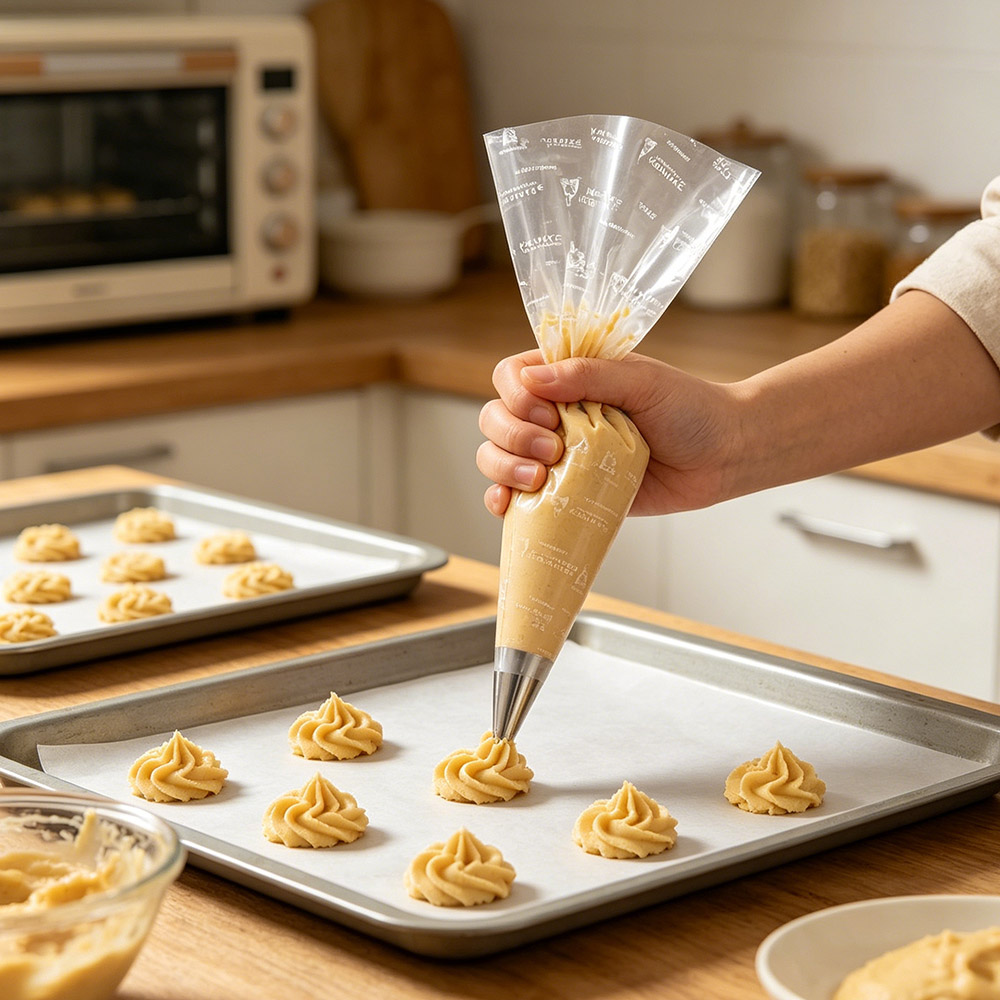
Baking piping bags, also known as pastry bags or dessert injection bags, are food-grade flexible tools designed to extrude liquids such as cream, batter, sauces, or chocolate. By pairing the bag with different piping nozzles, bakers can achieve cake decoration, dessert shaping, and ingredient injection. They are indispensable consumables in the baking industry.
II. Basic Structure of Baking Piping Bags
A standard piping bag consists of four main parts: the bag opening, the bag body, the tapered tail, and the sealed edge.
- Bag Opening: The inlet for food ingredients, often widened for easy filling.
- Bag Body: The main holding section, reinforced for pressure resistance.
- Tapered Tail: Designed for nozzle attachment; can be self-cut to size.
- Sealed Edge: Produced via high-temperature heat sealing to prevent cracking or leakage, ensuring no rupture during use.
III. Industry Positioning of Baking Piping Bags
Piping bags are categorized as disposable baking consumables and kitchen food contact tools. Key characteristics include low unit cost, high consumption, strong repurchase frequency, and consistent demand. With fast warehouse turnover and strong logistics adaptability, they are popular products for export and foreign trade in baking supplies.
IV. Materials and Characteristics
Currently, mainstream piping bags are classified into two main material categories: disposable food-grade plastics and reusable materials. Each material has distinct manufacturing processes, applications, export standards, and cost differences:
- LDPE (Low-Density Polyethylene)
– The most commonly used material in the industry.
– Food-grade, non-toxic, odorless, flexible, tear-resistant, and cold-resistant.
– Moderate transparency, soft hand-feel, resistant to oils and sticking.
– Ideal for high-fat ingredients such as butter and cream.
– Compliant with FDA and LFGB food contact certifications; best-selling in Europe and the United States.
– Limitation: Low heat resistance, softening above 60°C. - HDPE (High-Density Polyethylene)
– Harder than LDPE, matte frosted finish, lower transparency.
– Strong puncture resistance, excellent load-bearing capacity.
– Suitable for thick batters or dense sauces.
– Cost-effective, ideal for bulk wholesale in Middle East, Southeast Asia, and African markets.
– Limitation: Stiffer feel, lower extrusion smoothness. - PA+PE Composite Material
– Double-layer reinforced material with high toughness, anti-burst, and heat-resistant.
– Can withstand hot food up to 80°C.
– Smooth, translucent, and burr-free.
– Used in high-end commercial baking and food processing, popular in upscale supermarkets in Europe and the U.S.
– Limitation: Higher cost, targeting mid-to-high-end markets.
Material Distribution for Export and Wholesale
– LDPE single-layer bags: ~75%, suitable for most overseas clients.
– Composite reinforced bags: ~15%, high-end market.
– Fabric or silicone reusable bags: ~10%.
– Factory production focuses on disposable food-grade PE, complemented by reinforced high-end options to meet segmented overseas market needs.
V. Manufacturing Process of Piping Bags
Our factory employs fully automated production lines with no direct human contact with raw materials, ensuring food hygiene and high-volume efficiency, suitable for large-scale export orders. The complete production workflow is as follows:
5.1 Raw Material Selection and Blending
Use only new food-grade plastic pellets; no recycled materials. Add food-grade lubricants and anti-tear agents. Mix according to strict ratios to ensure flexibility and transparency. Raw materials undergo heavy metal and hazardous substance testing before storage.
5.2 High-Temperature Film Extrusion
Melt pellets at 180–220°C through an extruder to produce uniform plastic film. Thickness tolerance ≤0.02mm. Cool and roll the film for further processing.
5.3 Cutting and Tapered Bag Forming
Computer-controlled cutting machines cut the film to pre-set sizes. Molds form standard cone-shaped bags, ensuring uniform bag openings and tail diameters without deviations.
5.4 High-Temperature Heat-Sealing
High-frequency heat sealing for three edges, ensuring anti-burst and leak-proof performance. Removes defective edges to prevent leaks during filling.
5.5 Edge Trimming and Burr Removal
Automated trimming equipment removes sharp edges, preventing hand injuries. Optimizes hand-feel and product aesthetics.
5.6 Optional Printing and Customization
Eco-friendly, food-grade ink printing for logos, patterns, text, and size markings. Ink is baked and fixed; no peeling or odor, compliant with food safety standards.
5.7 Quality Inspection
Dual inspection by machine and staff. Checks for sealing defects, holes, thickness inconsistencies, and printing errors. Defective rate controlled below 0.3%, ensuring export quality.
5.8 Counting, Packaging, and Storage
Fully automated counting and packing; standard 50–100 pieces per pack. Packaging customized per customer requirements. Outer cartons: reinforced 5-layer corrugated boxes, moisture- and crush-resistant, with export labels. Stored in temperature-controlled warehouses.